Cremation urns are beautiful heirlooms that often remain on display for the ages either in a private home or a in a mausoleum on the ground of a cemetery or church. For guidance on how to honor a loved one with these urns, see A Guide to Hosting a Memorial for Cremation. These pieces of art have been called the most important of any because, well, they are the eternal symbol of a person’s entire life. It is for this reason that many families contract their cremation urn construction to skilled artists who can design and create exactly the piece they are looking for that will help capture the spirit of the deceased person perfectly. Further, it is also the reason many people choose to design, and even produce, their own cremation urn themselves.
While this art service is often made available for a very low cost, or even free, to people who are special to the artist (family members and very close friends), for families who are not well acquainted with an artist, the cost of hiring a stranger to produce a perfect cremation urn can often be prohibitive. But, thanks to the proliferation of cremation urns on the memorial products market in recent years, that need not necessarily be a problem. In today’s world, it is possible to peruse more than 10,000 different pre-made cremation urns via the internet (or, in some cases, printed catalogs) in just a few hours, and only the most hard-to-please personality will have difficulty finding a unique urn to match his or her needs precisely.
But, with such a selection of cremation urns available, questions can abound among consumers, many of whom, at any given time, are considering the purchase of a cremation urn for the first time ever. What are the advantages of a fully ceramic urn over a traditional cloisonne urn? for example. Are wood cremation urns as sturdy as metal urns? Or, can glass blowers really incorporate a person’s ashes into the design of the urn itself?
The answers to these questions (and others) may seem a little less mysterious to the newcomer to the world of memorial products if they are armed with a basic understanding of how each of the main types of cremation urns are made. So, without further ado, we offer you the following explanation of the making of cremation urns.
Making of Ceramic Cremation Urns
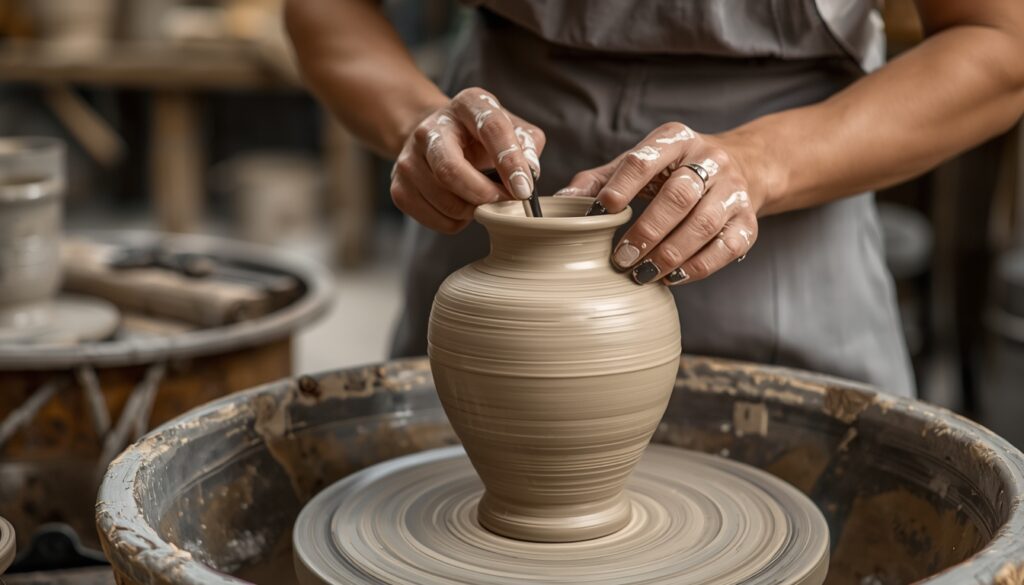
Ceramic urns start their life on drawing board in which an artist puts his vision to paper. Unlike other artistic crafts, however, the drawn plans for a ceramic urn (or anything ceramic) do not necessarily have to be precise. This is not a sky scrapper that’s being built, after all. (Though, of course, is is arguably even more important than that.) Armed with a rough idea of what the urn’s shape will look like, the urn sculptor is ready to go to the pottery wheel. There he or she uses the age-old traditions of the clay pottery craft to form a piece that will serve as the model for an urn to be mass produced and shipped to buyers across the world. Once the urn has taken its shape the artist uses it to create a mold by which the urn can be mass produced. The mold is then filled with liquid clay and then placed into a kiln where significant amounts of heat are applied for hours at a time, and the finished urns emerge ready for colored glazes to be applied. (Even when urns are mass produced with the mold, the glazes are often applied by hand, allowing for the personal touch that makes ceramic cremation urns so special. Though, of course, some manufacturers use an automated system to apply the glaze. This does not typically take away from the aesthetic beauty of the piece, however, it just means that the urns that are produced will all have a similar look. It is possible, however, to adjust the automated systems so that a wide variety of colors and designs appear on the urns, thereby assuring variety, even if the urn is not hand-painted.) The result of this process is a huge variety of urns that have all been hand-designed by a skilled artist.
Making of Cloisonne Cremation Urns
An intriguing alternative to ceramic urns is their cousin, the cloisonne cremation urn. These pieces tend to have a less-polished look that fools some who see them into believing that they are handmade even if they have been mass produced by an assembly-line type process. In short, it is often possible for even experts to discern whether a piece was made entirely by hand or whether it was manufactured by an assembly line with automated machinery. (This is not necessarily the case with ceramic urns, as those who are skilled in the craft of ceramic pottery can usually tell whether a piece has been created with a mold or is an original piece that a sculptor made directly on a pottery wheel.)
The cloisonne process is an age-old artistic tradition in which an artist sculpts an urn’s shape from a thin mess-wire material (many artists use something as simple and as common as chicken wire that can be found readily on many farms). Once it is securely in place in the shape that is intended, the artist then applies a ceramic coating to the wire, covering it completely. This procedure results in a somewhat rough texture that, in many cases, can be smoothed with the use of various pottery tools and a glaze coating. But, then, such techniques only end up mimicking the look of ceramic-only urns, and that might seem to erase the benefits of adopting a different production method entirely. So, one of the beauties of cloisonne urns is this versatility. This manufacturing process for an urn simply adds to the stunning variety of options that are available for those who are desiring to choose only the best, most perfect, cremation urn for their loved one’s permanent memorial.
One note about cloisonne urns that many people may consider a bit of a disadvantage: the metal skeleton part of the urn is usually (except in a few very creative cases) intended to be hidden beneath the ceramic walls of the urn. This can create problems for people who wish to transport the urn on a commercial airplane that will require passengers to submit their luggage to metal detectors. Though an x-ray of the urn can usually show that it does not contain dangerous weapons, many United States laws (as well as airline policies) simply prohibit passengers from bringing a cloisonne urn aboard a commercial jet liner. The issue here appears to be that the metal portion of the urn is hidden to the viewer’s eye. Many urns made exclusively from metal are allowed aboard air planes even after they have been flagged by metal detectors. To be sure, the information we discuss in this paragraph is subject to frequent change, and those who are planning to transport any cremation urn on a commercial airline would do well to discuss those plans with airline officials well in advance of the flight date.
Another advantage that cloisonne urns have over regular ceramic urns is their resistance to destruction. Those who own a cloisonne urn need not worry a significant amount over the possibility that the the piece will be destroyed if it is dropped or hit with some other heavy object. Granted, the clay walls of the urn likely not survive such an impact in tact, but the wire frame of the sculptured urn will likely remain in place and the clay can simply be restored on the walls. While the repair of a cloisonne urn that has been dropped may end up being tricky and even expensive, the bottom line is that it will almost always be possible. And, when one is talking about the eternal resting place of a loved one, it is often the case that no expense is worth sparing to preserve the urn. So, even though, – in other applications, repairing a piece of damaged cloisonne pottery might be considered cost prohibitive, it is likely a great comfort for families to realize that they will always be able to repair their beloved family member’s urn, should the need arise.
Making of Wood Cremation Urns
Wood cremation urns may be the most labor intensive of all urns that are available on the memorial product market. Even a one-inch piece of molding that plays only a small role in the overall design of the wood urn can require more than four or five special cuts on a wood artists’ saw. A great many hours goes into this type of work and, though, it can be automated, customizing the automation process – to allow for variety – is not as easy as it is in the case of the ceramic and cloisonne urns we mention above. Consequentially, though wood urns are beautiful, long-lasting pieces that can bring to mind memories of luxurious pieces of hard wood furniture that has been in a family for more than a century, the variety available on many websites and catalogs of cremation urns is sometimes lacking when compared to that of other types of urns. This is not to say that wood urns are somehow lacking in quality simply because their designs are not as varied, however. In many cases wooden urns can be more easily personalized than other urns. Because most wood urns feature flat walls rather than the rounded walls that are so common to ceramic cremation urns, they tend to lend themselves more readily to bronze plates that can be adhered to the urn to give the piece a personalized touch that includes the deceased’s name, dates of birth and death and, often, even a short epitaph. All that said, it should not be assumed that wooden urns are all flat pieces of rectangular or square shape. Quite the contrary, in fact. Many new saws and lathes have come about in recent years to help wood urn makers to produce pieces that have a smooth, vase-like shape that is as surprising as it is beautiful. In many cases on today’s memorial products market, wooden urns are available that will resemble ceramic urns so closely that viewers are often surprised to discover – only upon close inspection – that they are, in fact, wooden. This unique element of artistic intrigue is often a selling point for wooden urns today. Many people who have multiple layers to their personality will appreciate being remembered by an urn that is dramatically different than what it appears to be at first glance.
Making of Metal Cremation Urns
Metal cremation urns are sometimes considered the most traditional since their smooth, rounded look makes them similar to a chalice that is often used on religious proceedings such as the sharing of communion in many churches. These pieces get a lot of competition on the memorial products market from ceramic cremation urns, but, since they offer a bit of extra sturdiness, they are not likely to ever go entirely out of style, even if ceramic urns can out do them in terms of shapes and colors that are available. The properties of metal mean that urns made from steel and bronze are not prone to shatter into pieces as is the case with just about any other type of urn (except cloisonne urns, of course) and they are also resistant to water and other negative effects of weather. This means metal cremation urns are a popular choice for urns that are intended to be buried. In a few cases, metal urns have even been included in “time capsules” that are intended to be preserved in tact and opened in many decades or centuries as a means by which modern cultures can communicate their history with future generations. If one is interested in an urn that will be certain to last the ages, a metal urn is likely the best choice.
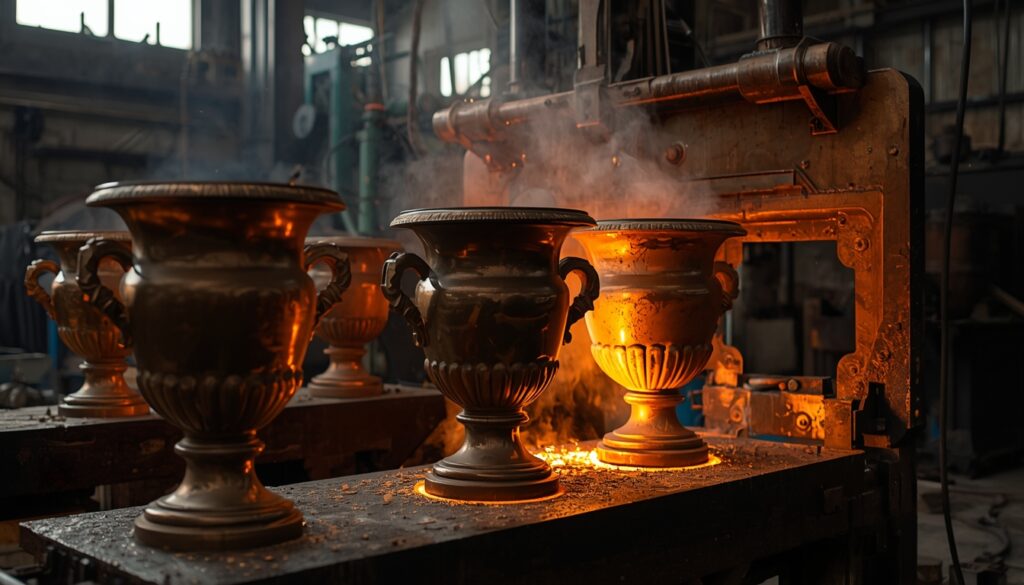
But what about the making of a metal cremation urn? Well, metal urns typically are manufactured by a process that is not a whole lot unlike the process used to create a ceramic urn. A famous, ancient process called “lost wax casting” is often the basis of the production process even in modern times. (The process has been updated in modern plants to incorporate the advantages that have come about by technological innovations, of course.) In this process an artist creates a mold to fit around a finished bronze (or even steel in some cases) piece that he or she has sculpted using standard metal sculpting techniques – just as a clay artist uses a pottery wheel to create the original model of a ceramic cremation urn. Once finished, liquid metal – usually bronze – is then placed in the mold and allowed to cool so that the urn forms inside the mold. The entire mold is then heated until the wax melts off of the urn (this is where the word “lost” comes into play). While this method is not followed precisely in today’s manufacturing environment, it is definitely the inspiration behind the automated systems that have come about in the industrial and technology age. Because molds are relatively easy to make after an urn has been created by a sculptor, there is no limit to the amount of creativity that can go into making metal urns. As long as artists are able to craft new designs from steel and bronze, new styles and varieties can be produced to give those looking for the perfect urn for a lost family member plenty of options to choose from.
Making of Glass Cremation Urns
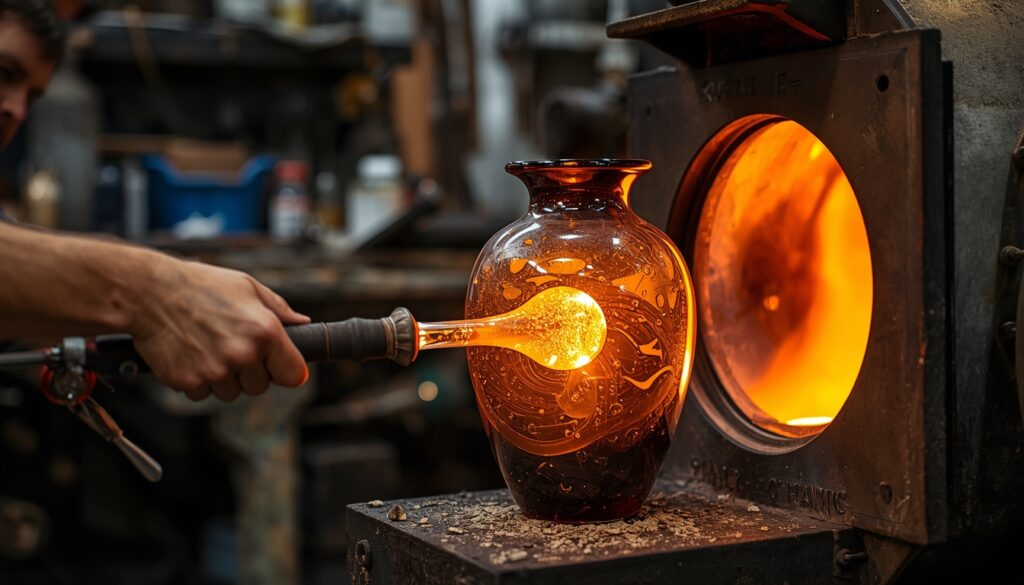
And, finally, glass cremation urns are, as with all the varieties of urns we have discussed in this article, originally crafted by an artist and then recreated in a factory setting using automated methods that are common to all parts of the glassware industry. Though a thorough description of the automated process is beyond the scope of this article, it is important to point out that every single piece – even if created by a machine based on the original work by an artist – is different. Glass blowing, by its nature, leads to variety. This can lead to frustration, ironically, among those who wish to select the perfect glass urn for their loved one: simply put, no manufacturer can guarantee that a glass urn that is shipped to a customer will look like one that is pictured. (In most catalogs and websites, any pictures of glass urns that are available for order are careful to point out that, while the shape of the urn can be expected to be the same as what is pictured, colors and other elements to the urn will likely be different no matter how much care the craftsmen may take). This is one reason why glass urns sometimes appear to be not as widely available as other types of cremation urns when a family is in the market for such a memorial. The other reason is that glass urns are generally considered more fragile than other urns. While it is true that these urns are not immune to being shattered upon contact with an object or even the ground, the truth is that they are also quite strong and sturdy in most cases and that it takes a great blow to damage them severely.